
20 Years Post Katrina
Louisiana’s public defender system is in the best shape that it has ever been. Today, Louisiana has a centralized public defender system. This system ensures continuity and compliance, provides training and tracks cases across the state in our criminal justice system’s only statewide database. On August 29, 2005, the landscape of public defense in Louisiana looked much different than it does today. Before Katrina made landfall bringing with her 120mph winds that devastated so much of the Gulf Coast, causing the levees to breach and producing some of the most horrific images that many of us have witnessed in our lifetime – there was no unified statewide system in this state.
Prior to Katrina, each judicial district had its own indigent defender board. At the statewide level, there was one entity, the Louisiana Indigent Defender Assistance Board (LIDAB), created by the Louisiana Legislature almost entirely as a pass-through entity to provide supplemental funds to district offices. In those days, public defense was funded almost exclusively by special court costs. In each case in which a defendant was convicted after a trial or made a guilty or no contest plea, the defendant was assessed a $35 special court cost that was deposited in the local Judicial District Indigent Defender Fund. In addition to those funds, the state was obligated to pay each district Indigent Defender Board the sum of $10,000.

As Katrina swept across the Gulf states, its aftermath laid bare the brokenness of the criminal justice system in Louisiana. Thousands of detainees, many of whom had not yet been convicted and/or who were charged with low-level offenses, were sent to parishes across Louisiana and to other states for housing with no files, no identification, and no attorneys willing or capable of representing them. Hurricane Katrina made it very clear that public defense in Louisiana needed an overhaul.
In 2007, the Louisiana Legislature overwhelmingly approved the Louisiana Public Defender Act, which for the first time created a centralized public defender system. This system was created based on the premise that it is the obligation of the legislature to provide for the general framework and the resources necessary to provide for the delivery of public defender services in this state. The Louisiana Public Defender Act created the
Louisiana Public Defender Board (now known as the Office of the State Public Defender) and ushered in a system which established standards and guidelines, a database to track case progress on the statewide level, an emergency operations plan, increased funding, training, and supervision.
From the beginning, funding public defense has been a challenge. When Katrina made landfall during Fiscal Year 2006, the state budget dedicated to public defense was only $9.4 million. As the Public Defender Act was implemented, the budget increased reaching $33 million in Fiscal Year 2011. The system then saw no significant change in funding for nearly a decade. Following legislation that increased special court costs from $35 to $45, Conviction and User Fee (CUF) collections peaked in FY2013, totaling $32.3 million followed by an immediate decline. As CUFs continued to decline and state supplemental assistance remained stagnant, districts burned through their fund balances creating fiscal crises in parishes across the state. Back in Baton Rouge, as the legislature grappled with similar fiscal issues within the state budget, it also attempted to address the issues facing the public defender system by passing legislation to change board membership and require that a minimum percentage of the Public Defender Fund be distributed to the districts. CUF collections would continue to decrease for a decade before bottoming out at $22.2 million in FY2022. Today, what was designed to serve as the system’s primary funding mechanism, now accounts for just 31% of all public defender revenues.
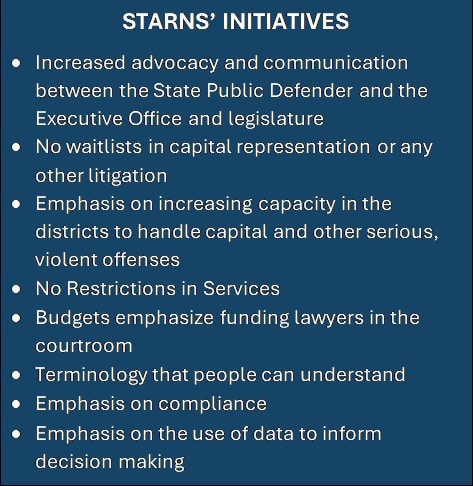
In January 2020, Rémy Voisin Starns was selected by the then Louisiana Public Defender Board to serve as the system’s third permanent State Public Defender. With a new vision for the office and the effects of the pandemic on court closures and CUF collections, the legislature stepped in and began providing additional state supplemental assistance. Mr. Starns’ appointment was later re-affirmed by Governor Landry, as he was appointed to serve as the first State Public Defender under 2024 legislation that abolished the Louisiana Public Defender Board and created the Office of the State Public Defender.
On the twentieth anniversary of Hurricane Katrina, the public defender system is stronger than ever. However, funding remains a critical issue. Louisiana’s funding mechanism is unstable and inadequate – premised on the notion of funding public defense primarily on the backs of its users. A new, stable funding mechanism is necessary to create avenues for retention and to keep up with the rising costs of attorneys and other ancillary expenses. Louisiana’s funding mechanism is unreliable – we simply cannot afford the criminal justice system that we have. Millions are dedicated towards capital punishment while only a tiny fraction of these cases impose a death sentence. Looking at opportunities to limit death penalty aggravators to ones that data shows result in actual death sentences; or amending eligibility to exclude defendants with specific mental health diagnoses would go a long way to reducing unnecessary public defense system expenses. Additionally, de-emphasizing an incarceration model as the first, or only, option to address the intersection between public health issues and petty crime and emphasizing rehabilitation is a better use of public resources and would improve the quality of life for all Louisianians. We can be proud of the improvements that have been made in the last 20 years, but we still have so far to go to turn Louisiana’s public defender system into the national model that we know it can be.